


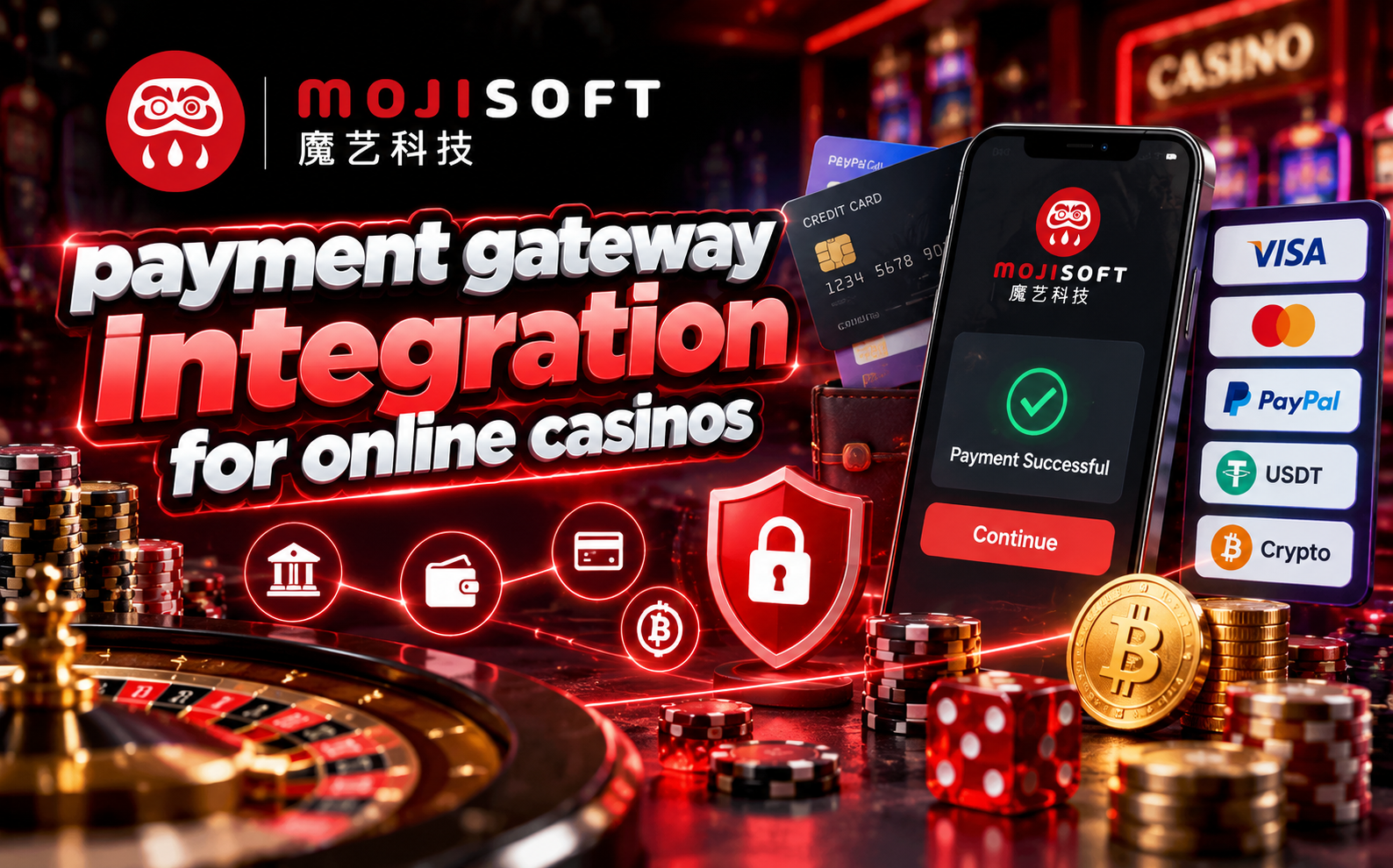
Money is the major evaluation criterion for an online casino. The ability to make a slow deposit or a stuck withdrawal recovery is going to be the end of a customer quicker than a bad game lobby will ever be. This is why the integration of payment gateway in online casino is the core of any gaming website development. It decides who you can serve, the safety of your transactions, and the ease of the player’s experience.
This guide is written in simple English. We discuss what gateways are, which payment methods are relevant, what to consider and how to set up gradually. We also review the typical problems and how a partner such as Mojisoft can help you to avoid them.
Why Payment Integration Matters for Online Casino Platforms
Integrating the payment gateway in the online casino implies that the casino’s platform is integrated with some payment gateway service provider that will allow the players to make deposits and withdrawals within the casino site. The gateway connects you to your platform and the financial network behind those platforms, and to the player.
How payment gateways work in iGaming
The casino sends payment details to the gateway via API when a player deposits. The gateway encrypts the data, sends it to the payment network for its approval and then awaits the approval. It takes less than a second to return with the result, and the player’s balance is updated. Withdrawals are the reverse, typically there are additional checks on the way.
The role of payment processors and acquiring banks
The gateway is not a standalone device. The payment processor is responsible for the technical aspects of transferring transaction information, while an acquiring bank owns a merchant account where the funds are deposited. Casinos are considered riskier merchants and it takes some research to find processors and banks that will accept iGaming. For this, a good casino payment integration plan is in place from day one.
Why Payment Integration Matters for Online Casino Platforms
Payment integration is essential for online casino platforms for several reasons.There are several reasons why payment integration is crucial for online casino platforms.
Payments are more than just a back-office chore. They influence the perception of your brand each day of the year.
Simplifying deposits and withdrawals
A robust system allows players to deposit money into their accounts in a few clicks and withdraw without having to bother with the help. It also means less manual work for operators and cleaner records, as well as less time spent on manually reconciling failed payments.
Supporting a smoother player experience
Players notice friction. They will remember if a checkout page is cumbersome, or if a withdrawal takes longer than stated. Payment gateway integration for online casinos is robust and clear, processing payments quickly and sending honest status messages, familiar payment methods.
Managing transactions across different markets
It is not long before you get into payment complications if you serve more than one country. There are favourite ways across each market, local currencies and local rules. A flexible iGaming payment integration allows you to enable or disable payment options by region without having to rebuild your platform.
Types of Payment Methods Used by Online Casinos
Most casinos provide a combination of ways, as no one approach really works for anyone.
Debit and credit card payments
Cards are easily recognized and trusted. They are suitable for making deposits, but you should be aware that some issuers don’t accept gambling transactions, and that some withdrawals back to cards may take more time. Be prepared to deal with declines and card verification rules delicately.
E-wallets and digital payment services
E-wallets are convenient as they ensure that the banking details remain out of the casino and are quick to use. Many players enjoy playing with them for their withdrawals as well. Some wallets are not available in all areas, so be sure to find out what wallets are legal and popular in your target markets.
Bank transfers and locally supported payment methods
In markets where cards are less prevalent, doors can be opened with bank transfers or the use of local options like regional instant-payment systems or vouchers. They are generally more complicated to set up, but can improve conversion in the right country.
Key Features of an iGaming Payment Integration System
Not all setups are the same. Here are the features to look at prior to committing.
Multi-currency transaction support
If you accept players from a number of countries, your system should support multiple currencies, provide clear exchange information and settle funds in the currency you wish. Players don’t like hidden conversion costs and it reduces your margin.
Transaction monitoring and reporting
A real time view of what’s going on is required. Successful and unsuccessful payments, approval rate, pending withdrawals and trends over time are shown in good dashboards. Clear reports assist your finance and support teams to respond to questions promptly.
Fraud detection and payment security.
Fraud is a threat at the casino, whether in the form of card theft or the misuse of casino bonuses. Search for instruments that highlight strange behavior, like large deposits that occur in a short time frame or numerous failed login attempts. Implementation of such standards as PCI DSS is also a basic expectation of anyone with card data.
Payment reconciliation and error handling.
Reconciliation is comparing your platform’s totals to the totals from the bank or provider. Automated reconciliation saves hours and hours! Error handling is just as important: If a player times out or requests a duplicate, his balance will not be incorrect.
How to Integrate a Payment Gateway Into a Casino Platform
Now let us consider how integration of a payment gateway takes place in an online casino in a step-by-step manner.
Identify business and market requirements
Begin with the countries you want to play in and the volumes, currency and payment options you need there. Also review licensing requirements as your regulator may have restrictions on some techniques or may necessitate specific checks.
Select compatible payment providers
Select iGaming merchants that are accepted, ensure your markets are supported and ensure they have good API documentation. Research the costs, processing speed and customer service. It’s also wise to select two or more providers, which means that if one goes down, your business isn’t down as well.
Configure APIs and transaction workflows
Your developers then implement the APIs and create the workflows around deposits, withdrawals, and reversal and refund operations. Establish specific statuses like pending, approved, failed, and cancelled. Make sure every status calls the correct function for the player’s balance.
Test deposit, withdrawal and failed transactions
Test the happy path, and spend even more time on the unhappy ones. Test out declined cards, expired sessions, duplicate clicks, and partial payments and network drops. Try out the provider’s sandbox first, then test it out with small groups before it is open to all.
Monitor performance after launch
Launch is not the end! Monitor Approval rates, Processing times and Support tickets. When one approach fails in a specific nation, modify it or switch to another approach. Casino payment integration is sustainable over time, thanks to ongoing tuning.
Common Challenges in Casino Payment Integration
Even highly experienced teams have a few common issues.
Payment declines and processing delays
Some banks deny gambling payments or some transactions just time out. Provide other options when players check out, provide clear error messages and communicate with players about any expected withdrawals to avoid triggering panic.
Regulatory and verification requirements
Licensed markets are standard to perform KYC and AML checks. They are there to safeguard players and operators, but can slow down if documents are missing. Include verification during the sign up process, so players are ready before they make their first request.
Managing multiple payment providers
The more providers, the more contracts, the more API, the more reports. If not managed at a central level, it becomes a mess in no time. A number of operators utilize one interweaving layer which is positioned over all operators.
How to Choose the Right iGaming Payment Solution
A good choice is a months’ worth of rework. Follow this easy checklist.
Compare supported countries and currencies
Be sure to include both existing and new markets in your solution. At the local level, use other ways to check, not only cards.
Evaluate security, costs and integration support
Take into account the overall cost inclusive of setup, transaction fees, chargeback fees, and currency conversion. Find out about any security certifications and responsiveness to technical problems.A good integration support is worth actual money.
Check licensing and compliance requirements
Make sure that the organization can recognize the kind of license that you have and whether its regulatory body permits that. Inquire what papers they require from you. A provider who is aware of the iGaming compliance will save you from unpleasant surprises.
How White-Label Casino Software Can Simplify Payment Integration
Making things from scratch requires some time, especially when it includes games and a back office system as well. White label casino software provides you with a platform ready to go, and frequently includes payment methods and provider connections, enabling you to launch quicker.
The advantage is that your team doesn’t spend so much time on plumbing and more time on marketing and player care. Many operators operate in this niche, and Mojisoft is one of the companies assisting them in establishing their iGaming platform with a payment system that aligns with their markets.Always know about their payment methods and how new providers will be incorporated when choosing any white label service provider. Also find out who will respond to compliance questions.
Frequently Asked Questions
What is an iGaming payment gateway?
An iGaming payment gateway is a service that safely transfers payment information between a player, an online casino and the financial network. It will encrypt the data, ask for approval and return the outcome, allowing deposits and withdrawals to take place safely and quickly.
How does payment gateway integration work for online casinos?
The gateway interacts with your platform via APIs. Once a player pays, it is passed onto the gateway, processor and the bank and the approval is then returned within seconds. The withdrawal process is similar, typically including verification and review procedures.
What are the varieties of payment methods in an online casino?
This can be done using debit or credit cards, bank transfer or local payment methods, such as e-wallets. Certain casinos may also accept vouchers or cryptocurrency, based on the licensing and market regulations they observe. The combination is different according to your players’ residences.
How can casino operators improve payment security?
Always go for vendors that are PCI DSS compliant and have your data encrypted, fraud monitoring conducted, and data validation made strict when you are requesting withdrawals.The most important thing about detecting any type of fraud is that it should be done promptly, and your software should always be updated.
What should businesses check before choosing a payment provider?
Check that the countries and currencies are accepted, iGaming, cost, clearing time, security needs and technical support. Check that the site complies with any licensing or regulatory requirements. Ask for a test site in order to be able to test the system.
Leave a Reply